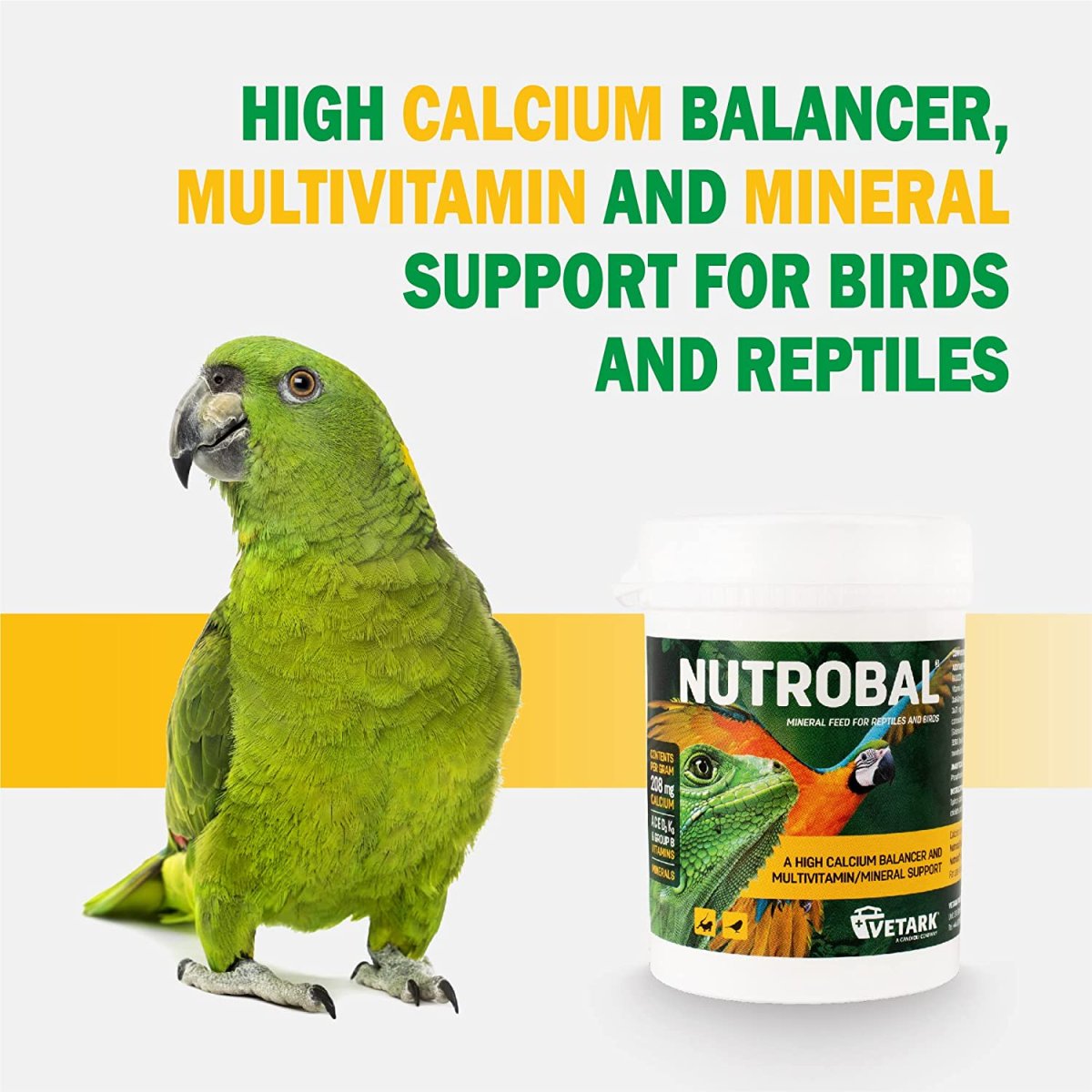
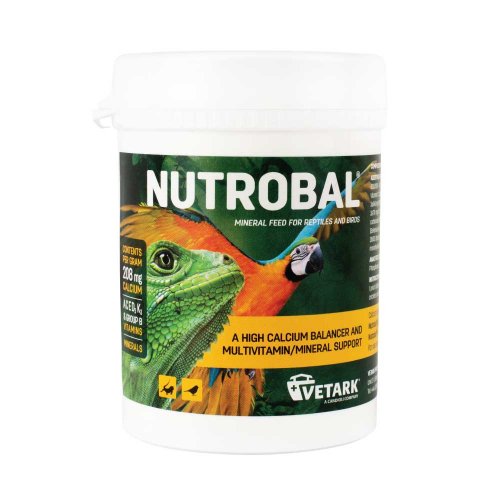
Calcium deficiencies occur readily in exotic species such as reptiles and birds. Nutrobal is a vitamin and mineral feeding stuff providing a high potency calcium source. Nutrobal also contains vitamin D3 in sufficient levels to mobilise the calcium provided.
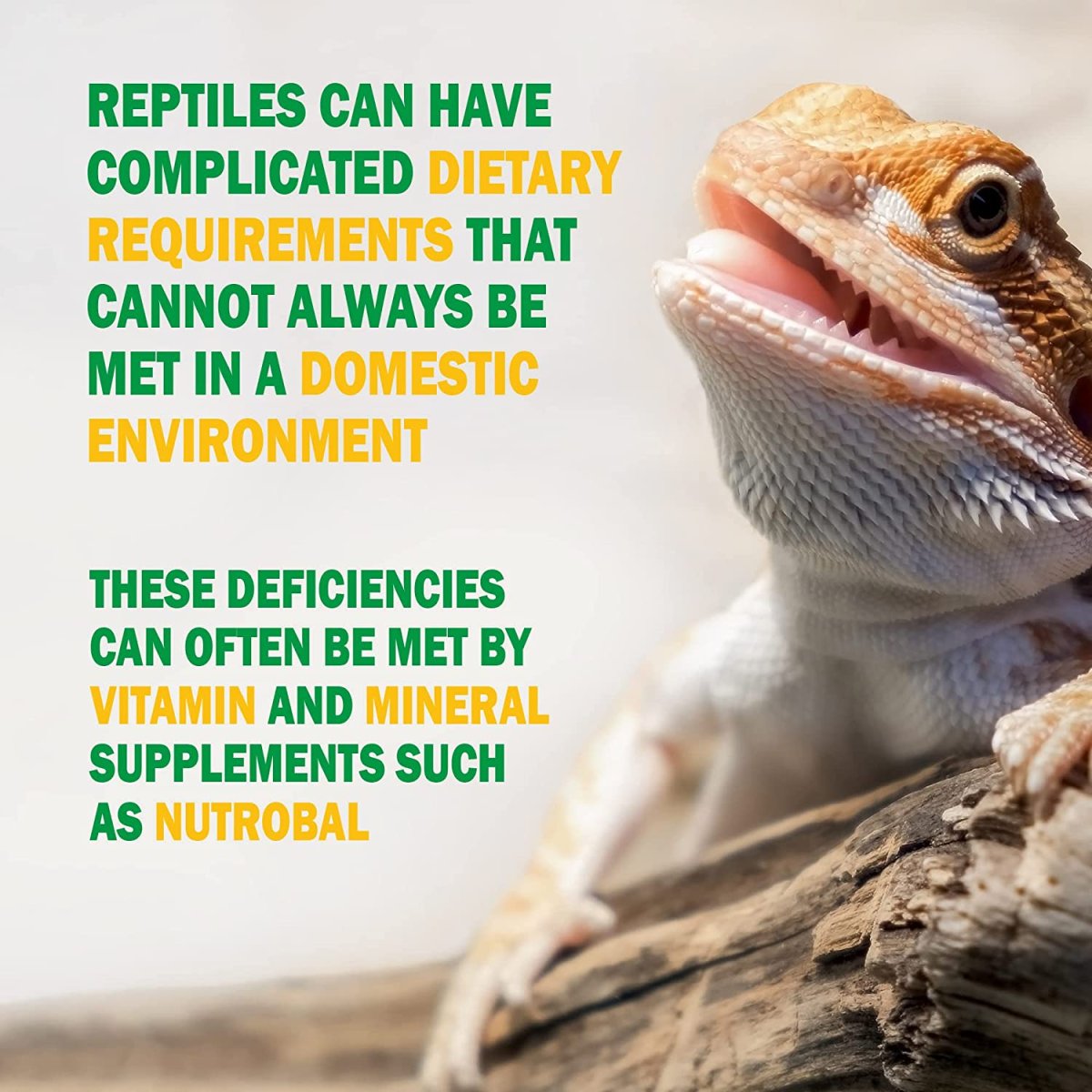
Reptiles can have complicated dietary requirements that can’t always be met in a domestic environment, but in most instances these deficiencies can be met by vitamin and mineral supplements. Nutrobal comes in powder form that can easily be added to the food, including being dusted onto live food such as crickets, locusts and mealworms for insectivores, and will optimise the health of your pet reptile when given at the correct doses. The Calcium:Phosphorus ratio is extremely important in ensuring healthy bone growth in reptiles, and supports the reproductive function with a potent Ca:P ratio of 46:1.
It is not only insectivores who will benefit from our high calcium supplement, larger reptiles (including crocodiles) fed on a mainly meat diet will also benefit greatly from the additional support for normal bone development. Growing tortoise and turtles need calcium for their shells, without it they can experience calcium related deficiencies such as pyramiding of their shells.
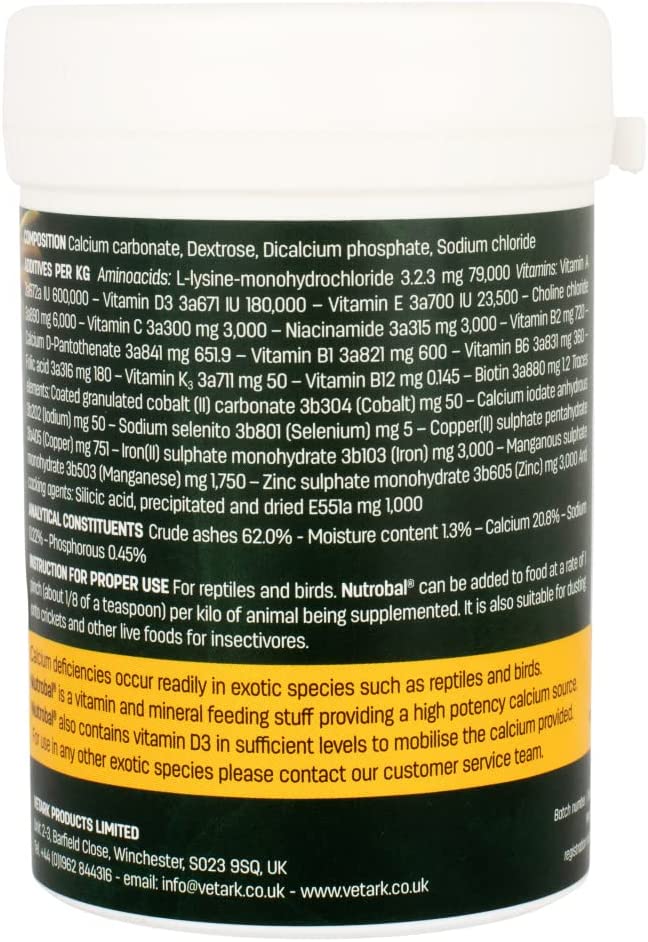
Calcium carbonate, Dextrose, Dicalcium phosphate, Sodium chloride
ADDITIVES PER KG: Aminoacids: L-lysine-monohydrochloride 3.2.3 mg 79,000. Vitamins: Vitamin A 3a672a IU 600,000 – Vitamin D3 IU 180,000 – Vitamin E 3a700 IU 23,500 – Choline chloride 3a890 mg 6,000 - Vitamin C 3a300 mg 3,000 – Niacinamide 3a315 mg 3,000 - Vitamin B2 mg 720 – Calcium D-Pantothenate 3a841 mg 651.9 - Vitamin B1 3a821 mg 600 – Vitamin B6 3a831 mg 360 – Folic acid 3a316 mg 180 – Vitamin K3 3a711 mg 50 – Vitamin B12 mg 0.145 – Biotin 3a880 mg 1.2. Traces elements: Coated granulated cobalt (II) carbonate 3b304 (Cobalt) mg 50 – Calcium iodate anhydrous 3b202 (Iodium) mg 50 – Sodium selenito 3b801 (Selenium) mg 5 - Copper(II) sulphate pentahydrate 3b405 (Copper) mg 751 - Iron(II) sulphate monohydrate 3b103 (Iron) mg 3,000 - Manganous sulphate monohydrate 3b503 (Manganese) mg 1,750 - Zinc sulphate monohydrate 3b605 (Zinc) mg 3,000. Anti cacking agents: Silicic acid, precipitated and dried E551a mg 1,000.
Calcium 20.8% - Sodium 0.22% - Phosphorous 0.45%
Nutrobal can be added to food at a rate of 1 pinch (about 1/8 of a teaspoon) per kilo of animal being supplemented. It is also suitable for dusting onto crickets and other live foods for insectivores.
Q. My tortoises are too small to hibernate but are dozy all the time, as they are not eating anything I would like to know if it is possible to put Nutrobal in the water as they bathe?
A. Nutrobal is for dusting on the food, it isn't water soluble. If you are keeping the tortoises awake through the winter you will need a proper vivarium and heat lamp, otherwise they will simply stay half-awake not eating and losing weight - just bathing them daily isn't enough. Please contact a local vet for more advise.
Q. I purchased a tub of Nutrobal for regular dusting of crickets for my Leopard & Crested Geckos. Usually, my Leopard Geckos are happy to eat a calcium supplement straight from a food bowl, and I was just wondering whether it is safe to use the Nutrobal in a similar fashion?
A. Nutrobal isn't formulated to be fed from a bowl, it is designed for dusting onto food or coating crickets. That means they get the right level of D3 and the other vitamins in Nutrobal. We suggest dusting all your crickets with Nutrobal and leave access to calcium such as Calci-Dust in the food bowl.
Q. Is it ok for Nutrobal to be the only source of calcium for young veiled chameleon females and whether once a week is sufficient?
A. We would recommend Nutrobal and Calci-Dust on alternate feeds. If you only dust once a week then all that happens is that the animal avoids the white crickets because tomorrow there will be a brown one.
Q. I keep seeing reports that say vitamin D3 deteriorates fast - is it true?
A. Yes, vitamin D3 can deteriorate quickly. We are aware of a lot of debate on this and we have tried to clarify it. The particular vitamin D3 we use has been tested in harsh conditions - up to a temperature of 40C and has been shown to deteriorate at a rate of less than 1% a month. We already include a small overage in the product to compensate for this, so we are confident that adequate levels are there to exceed the 6-9 month product expiry date.